
How to obtain Tax residency in Singapore (COR)
And how it can be used for an Avoidance of Double Taxation Treaty

When it comes to paying taxes in different jurisdictions connected to your Singapore company, or paying out dividends through Singapore, getting tax residency confirmation is almost an unavoidable step. In practice, that means applying and receiving a Certificate of Tax Residency (COR) for the company from IRAS. In order to do it, it is necessary to establish that your company’s control and management are exercised in Singapore. Only then you will be able to obtain a Certificate of Tax Residency Singapore (COR) and apply to foreign tax authorities for the treaty benefits.
In this article:
- What is “Singapore tax residency” and its meaning for business
- How it matters in terms of access to DTAs and credits
- Necessary attributes for a Certificate of Residence
- Ongoing support of Singapore Tax residency requirements
- Additional considerations
- Typical reasons why applications for COR get rejections
- Practical timeline when applying for COR for a small group
- Frequently asked questions
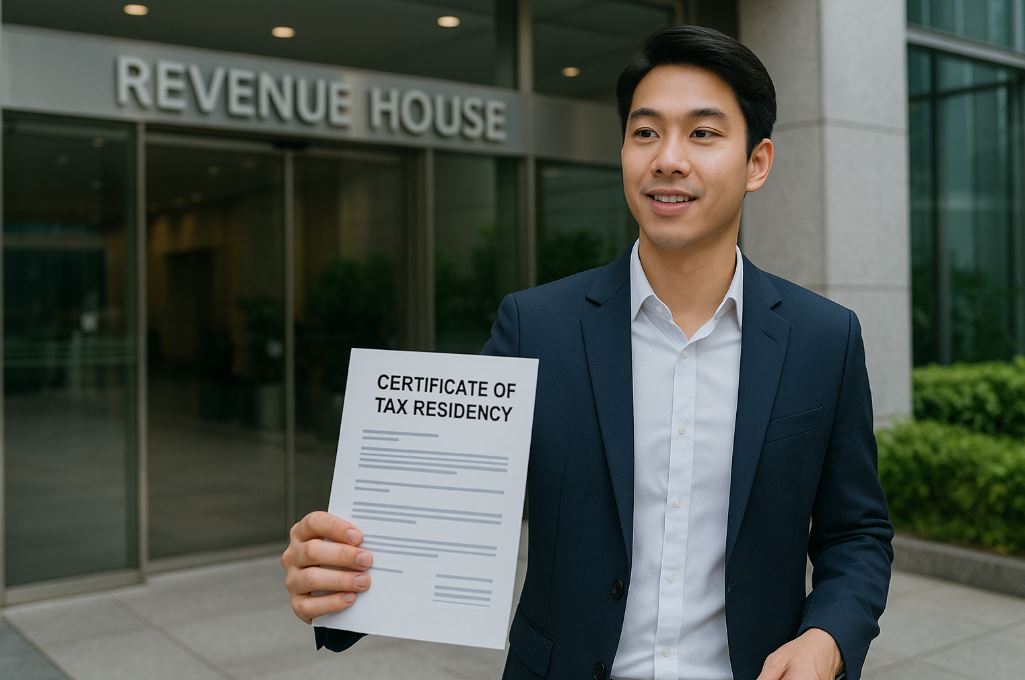
What is “Singapore tax residency” and its meaning for business
When determining the tax residency status of a Singapore company, Singapore tax authorities (IRAS) look at not just where the company is incorporated and pays its taxes, but where key decisions are made. For example, if strategy, budgets, financing, and big contracts are decided in Singapore (e.g., at board meetings held here), then the company will likely qualify for Singapore tax residency.
It is also important to remember that tax residency is assessed each year; and therefore, the Certificates of tax residence issued are also valid for one year only.
It is also important to remember that tax residency is assessed each year; and therefore, the Certificates of tax residence issued are also valid for one year only.
Typical evidence that IRAS expects to see include:
- Board meetings are held in Singapore where real decisions are made and recorder.
- Key executives (director/CEO/CFO) are regularly making decisions from Singapore.
- Having an Operational substance: local office, operational team, some decision makers and executives, and/or routine admin in Singapore.
Recent guidance tightened expectations for hybrid/virtual boards—it’s still possible, but you must show that decision-makers are in Singapore when decisions are taken.
How it matters in terms of access to DTAs and credits
Singapore-resident companies, which are able to confirm their residence status by Certificate of Tax Residency, can claim Double Tax Agreement (DTA) benefits, such as reduced withholding tax rates on dividends, interest or royalties and relief from double taxation.
Where tax is also paid overseas, the company can claim foreign tax credit in Singapore on the same income. To activate treaty rates abroad, you usually present a COR issued by IRAS. The Certificate is also often required to be Apostilled or Legalised for a particular country – read about these services which we can also provide: Apostille and Legalisation
Necessary attributes for a Certificate of Residence
Below are the general recommendations which may help you keep the company matters compliant with the required Singapore tax residency rules:
- Get your governance in order. Schedule board meetings in Singapore; keep detailed minutes showing strategic decisions.
- Confirm substance. Keep a local office, maintain books in Singapore, and have at least one decision-making executive based here (helps a lot for foreign-owned holdings).
- Apply via myTax Portal (CorpPass) for the relevant YA; attach supporting info if asked. CORs are year-specific; some partners accept forward-dated CORs for the current year once issued.
If a treaty partner needs their own tax reclaim form certified, IRAS can stamp that instead of (or alongside) a COR.
Ongoing support of Singapore Tax residency requirements
As mentioned earlier, the status of companies can change and therefore it can be re-assessed from time to time. Certificates of Tax residency in Singapore are issued with a validity of One year. Therefore, in order to continue receive certificates in the following years, the same conditions must be continuously met:
- Hold (and minute) board meetings in Singapore. Avoid “rubber-stamping” foreign decisions.
- Base a key exec in Singapore. Even one empowered director/CEO on the ground strengthens your case.
- Keep the core admin here. Accounting, records, and company secretarial work in Singapore signal real control.
- Use Singapore banks and service providers. Day-to-day treasury and contracts being managed in Singapore support substance.
Document everything. Board packs, hiring letters, service contracts, and lease agreements become your residency file.
Additional considerations
- Foreign-sourced income rules. If you plan to remit foreign income to Singapore (dividends, branch profits, service income), check Section 13(9) of Singapore Income Tax Act conditions for exemption: subject-to-tax overseas, foreign headline rate ≥15%, and beneficial to the Singapore company. Keep paperwork (dividend vouchers, audited accounts) ready.
- Disposal gains from foreign assets. From 1 Jan 2024, certain foreign disposal gains received in Singapore can be taxable under section 10L unless substance conditions are met—another reason to beef up local decision-making and functions.
- Holding companies. Foreign-owned, pure holding entities face closer scrutiny. Hybrid/virtual boards are fine only if you can show control was exercised in Singapore (e.g., director location evidence, timed minutes).
Typical reasons why applications for COR get rejections
- Meetings “on paper” only (minutes don’t show real decisions).
- All executives abroad and no empowered director in Singapore.
- Ops elsewhere (finance, sales contracts, cash management run outside Singapore).
Mismatch of years (asking for a COR for a year when decisions were abroad).
Fix the gaps first, then re-apply with stronger evidence.
Practical timeline when applying for COR for a small group
- Month 0–1: Appoint/resettle a decision-maker in Singapore; calendar board dates here; align banking and bookkeeping.
- Month 2–3: Hold the first Singapore board; minute strategy/financing decisions; tidy the residency file.
- Month 3–4: Apply for the COR for the relevant YA; submit reclaim forms for treaty partners that require them.
Bottom line
Residency is about substance and evidence. If you centralise decision-making in Singapore and keep clean records, IRAS will usually issue a COR—and your counterparties can apply treaty rates with confidence. ASEAN Briefing’s takeaway is the same: genuine management and control in Singapore is the unlock for treaty relief.
Feel free to reach out to us today!
Frequently Asked Questions
How do we apply for COR?
Should a company apply for a Certificate of Residence through writing?
Can a tax agent apply for a Certificate of Residence on behalf of a company?
Do DTA partners accept digital copies of a COR?
What’s the typical processing time?
Is there a government fee?
What period does the COR cover?
Apply for Certificate of Tax residency in Singapore Today
Talk to the experts!
Contact Intraconnect Pte Ltd to get expert guidance, fast processing, and compliant service.