
GST: Goods and Services Tax in Singapore
The Complete Guide on requirements and filing
Introduction to GST
The Goods and Services Tax (GST) is Singapore’s consumption tax, administered by IRAS and currently charged at 9% — but a meaningful share of the questions we get aren’t about how to charge it, they’re about whether a company needs to charge it at all. This guide covers both: registration, filing, and rates, and a detailed look at when GST genuinely doesn’t apply, which matters a lot for foreign-owned and offshore-oriented businesses specifically.
GST for Singapore Companies
Companies are not automatically GST-registered. If you meet the registration criteria below, you must apply to IRAS before you’re permitted to charge and collect GST. Once registered, if you charge S$100 for a service, you invoice the customer S$109 (S$100 plus 9% GST), and that GST amount is remitted to IRAS through quarterly filing.
GST Registration
Compulsory Registration
If your taxable turnover exceeds S$1 million by the end of the calendar year, you must register by 30 January, effective 1 March (retrospective basis). If you’re currently trading and reasonably expect turnover to exceed S$1 million over the next 12 months, you must register on a prospective basis — apply within 30 days of forming that expectation. For forecasts made on or after 1 July 2025, IRAS extended this to a 2-month window from the forecast date, giving businesses more time to prepare.
Voluntary Registration
You can register voluntarily below the threshold if you’re making or planning to make taxable supplies in Singapore. Conditions: remain registered at least 2 years, file quarterly returns, and keep records for 5 years. One 2026-specific requirement: new voluntary registrants must transmit invoice data via the InvoiceNow network (the Peppol e-invoicing standard) from 1 April 2026.
When GST Is Not Required
This is where most of the confusion happens, and it’s worth walking through properly rather than treating it as a footnote. GST applies to “taxable supplies” — but a significant amount of legitimate business activity simply falls outside that definition entirely. There are three distinct situations, and they’re not interchangeable.
1. Out-of-Scope Supplies — Not GST at All
These are transactions that fall outside Singapore’s GST system entirely — not taxed at 0%, simply not in scope. You don’t charge GST on them and don’t report them on your GST return at all. Common examples:
- Goods sold and delivered directly between two overseas locations, never entering Singapore — e.g. a Singapore company sells goods manufactured in Vietnam directly to a customer in Japan, with the goods never touching Singapore soil
- Sales of overseas goods within a Free Trade Zone or Zero-GST Warehouse
- Private, non-business transactions
This is the category most relevant to foreign-owned companies using Singapore as a regional base without local delivery — if your goods or services never actually land in or are consumed in Singapore, GST may simply not apply to that revenue stream.
2. Exempt Supplies — Specifically Excluded by Law
These are supplies the GST Act specifically carves out. Unlike out-of-scope supplies, exempt supplies are still “in the system” conceptually — but no GST is charged on them, and importantly, you generally can’t claim input tax credits on purchases related to making them. Main categories:
- Most financial services — loan and mortgage interest, life insurance policies, financial derivatives
- Sale or long-term lease of residential property
- Supply of investment precious metals (gold, silver, platinum meeting specific purity/form criteria)
- Digital payment tokens (e.g. certain cryptocurrency transactions)
3. No Local Taxable Turnover — the Offshore Business Scenario
This is the one that matters most for genuinely offshore-oriented structures, and it’s worth stating plainly: when IRAS calculates whether you’ve crossed the S$1 million registration threshold, exempt supplies, out-of-scope supplies, and proceeds from selling capital assets are all excluded from that calculation. A company can have substantial global revenue and still have zero — or near-zero — Singapore taxable turnover, if its actual activity is genuinely offshore (holding structures, regional coordination, or services and goods that never touch or aren’t consumed in Singapore). In that situation, GST registration simply isn’t triggered, regardless of the company’s overall size. This is a common structure for offshore companies using Singapore as a base — but it depends entirely on the actual nature of your supplies, not just an intention to “operate offshore,” so it’s worth confirming your specific structure with an advisor rather than assuming it automatically applies.
Existing IRAS Exemption From Registration (a separate, narrower rule)
Distinct from the above: if your business already exceeds the S$1 million threshold but more than 90% of your total taxable supplies are zero-rated (see below) and your input tax exceeds your output tax, you can apply to IRAS for an exemption from registration — avoiding the administrative burden of quarterly filing despite technically crossing the threshold.
Zero-Rated vs. Standard-Rated Taxable Supplies
Taxable supplies — the ones that do count toward your registration threshold — split into two types: standard-rated (currently 9%, covering most domestic goods and services) and zero-rated (0%, covering exports and international services). Zero-rated supplies are still taxable supplies for threshold purposes, just charged at 0% — don’t confuse them with the exempt or out-of-scope categories above, which are excluded from the threshold calculation entirely.
- Standard-rated examples: local sale of goods, local professional services, F&B, commercial property sale/lease
- Zero-rated examples: exported goods, international services provided to overseas clients
De-Registration
- Business operations cease
- The business is sold entirely to another party
- Your turnover no longer exceeds S$1 million and you choose to deregister
File the de-registration application within 30 days of the relevant date.
GST Filing and Refunds
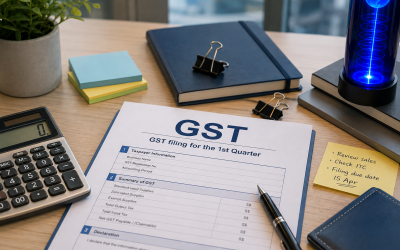
GST-registered entities file a GST return (Form F5), typically quarterly, reporting local sales, exports, purchases, and GST collected/claimed. Returns are filed electronically via myTax Portal, due one month after the end of your accounting period.
GST Registration Procedure
Register using Form GST F1 (plus Form GST F3 for partnerships), with supporting documents. Separate procedures apply for overseas companies, group registration, and divisional registration. Processing takes roughly three weeks; you’ll receive a Notification of GST Registration with your GST number, effective date, and filing details.
GST Schemes to Aid Businesses
- Cash Accounting Scheme — account for GST when payment is received/made, not on invoice date
- Discounted Sale Price Scheme — GST charged on the discounted price only
- Gross Margin Scheme — GST charged on profit margin, not full sale price
- Hand-Carried Exports Scheme — GST refund on goods carried out of Singapore as personal luggage
- Import GST Deferment Scheme (IGDS) — defer GST on imports until goods are sold/used
- Major Exporter Scheme (MES) — defer GST payment for businesses exporting significant volumes
- Tourist Refund Scheme — GST refund for tourists on goods taken out of Singapore
- Zero-GST Warehouse Scheme — store imported goods without paying GST until sold/exported
2026 Compliance Notes
- If you register late, IRAS will waive the fine and 10% penalty for businesses that voluntarily disclose the late registration — though backdated GST remains payable regardless
- New voluntary GST registrants must adopt InvoiceNow (Peppol) e-invoicing from 1 April 2026
- Misclassifying supplies — particularly treating zero-rated exports as out-of-scope, or vice versa — is one of the more common compliance errors IRAS flags in audits, since the two categories are taxed identically (0%) but treated completely differently for threshold and reporting purposes
Need Help With GST Registration or Compliance?
Whether you need to register, want to confirm you're genuinely exempt, or need ongoing GST filing support, we can help assess your specific situation. This pairs closely with our broader corporate tax guide — get in touch for a consultation.
Click Here
Singapore Corporate Tax calculator
We provide a very easy tool to estimate your corporate...
Read More
A Complete Guide to Singapore Corporate Tax (2026)
Singapore companies are required to file 2 types of corporate...
Read More
Accounting Services in Singapore
OUR SERVICES: ACCOUNTING Powered by smart tools — from spreadsheets...
Read More