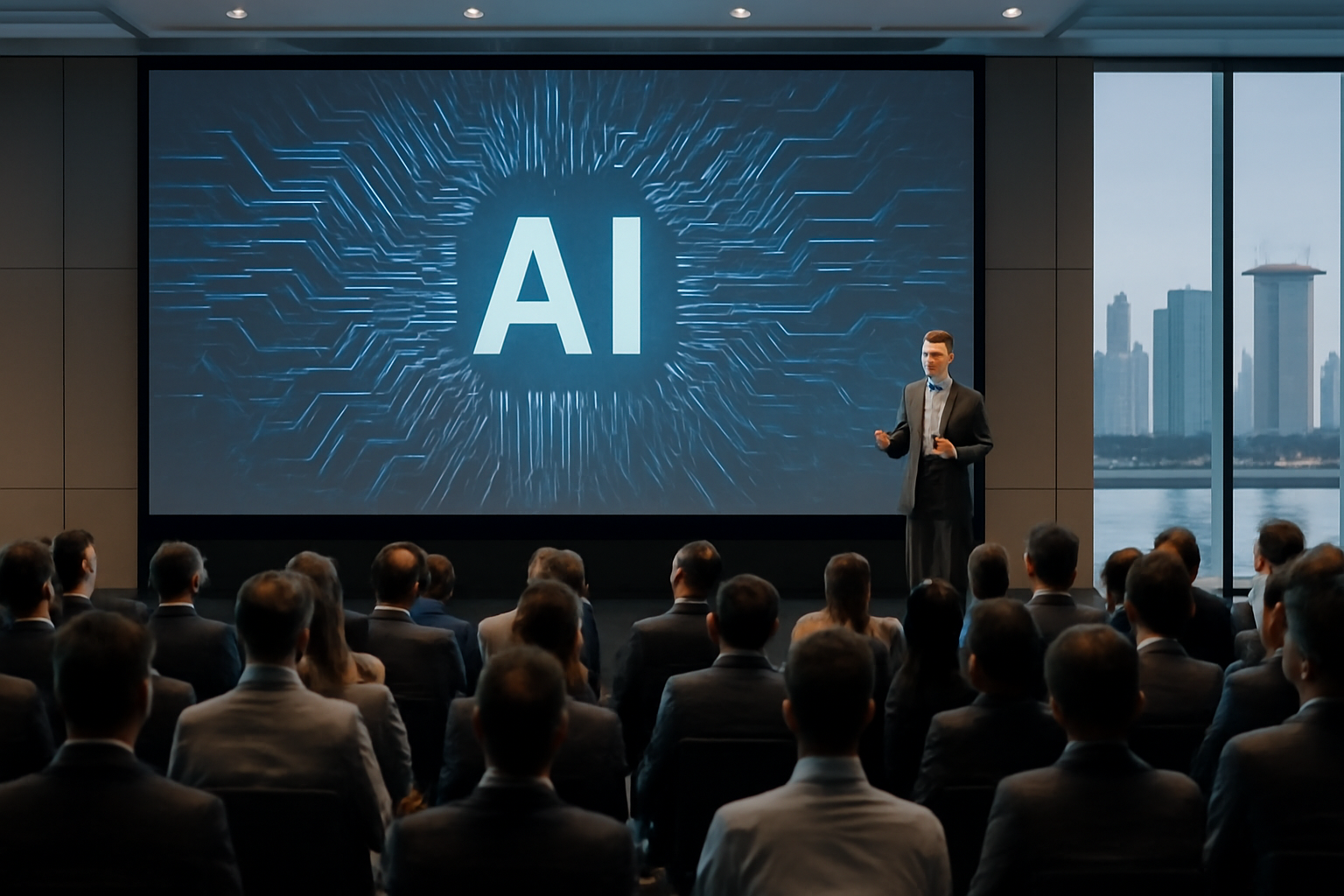

Singapore this week unveiled MARVEL‑AI, a government‑backed initiative that aims to compress timelines in materials research by combining advanced AI models with automated laboratory workflows. Announced at the Singapore Week of Innovation and Technology (SWITCH) on Oct 27, the programme is led by the Agency for Science, Technology and Research (A*STAR) and begins with an initial S$150 million of public funding.
MARVEL‑AI accelerates materials discovery
A*STAR researchers say the platform can substantially reduce discovery and validation cycles. Professor Loh Xian Jun, executive director of A*STAR’s Institute of Materials Research and Engineering, told Channel NewsAsia that AI‑assisted platforms and lab automation can shorten discovery time “by maybe up to 10 times.” He cited a hydrogel developed by his team — intended as a possible treatment for retinal detachment — as an example where AI helped generate and screen many candidate formulations far faster than traditional bench work.
MARVEL‑AI is framed explicitly as an industry‑facing tool: companies will be able to partner with researchers to target specific industrial problems, accelerating prototyping and reducing the time and costs that normally burden R&D projects.
Faster simulation, but not a replacement for testing
The impact of AI extends beyond materials science. Firms using physics‑aware AI for design and simulation say the technology can expand where high‑fidelity modelling is practical in product development. Jacomo Corbo, CEO of deep‑tech AI firm PhysicsX, told CNA that the company has accelerated simulation workloads by factors ranging from tens of thousands to, in some cases, orders of magnitude higher — enabling simulations to be used in stages of the lifecycle where they were previously too slow to be practical. He also reported a near‑20% reduction in development time for a new semiconductor equipment machine after applying these tools.
Yet speed must be balanced with accuracy. Corbo warned that “hallucination” — when AI produces plausible‑sounding but incorrect outputs — remains a real risk. He and Prof Loh stressed the need for physical validation and established safety limits, particularly where design errors could have serious real‑world consequences.
From lab to market: commercialisation, business implications and policy
Speakers at SWITCH and other recent industry events highlighted a persistent bottleneck: translating lab breakthroughs into commercially viable, scalable products. Prof Loh pointed to classical scale‑up challenges — producing grams in a lab is far removed from producing tonnes for manufacturing — and noted complex, hard‑to‑predict factors such as heat and mass transfer that complicate industrialisation.
That observation echoes wider experience in Singapore’s innovation ecosystem. New initiatives across universities and enterprise support aim to close the so‑called “valley of death” between discovery and market. For example, NUS Enterprise has rebranded and expanded into NUSX with an intensified focus on turning deep‑tech research into ventures and international pathways; NUSX’s Sept 24 announcement highlighted AI tools (such as its Nova engine) to surface commercial opportunities for university patents and accelerate licensing or spin‑out decisions. Such platforms aim to give researchers faster, evidence‑based insight into potential industrial partners and markets.
For corporates and industrial manufacturers, MARVEL‑AI and related tools offer a way to de‑risk early R&D and shorten time to prototype — potentially reducing procurement and development costs when working with research institutions. Firms that can integrate AI‑driven discovery with pragmatic scale‑up plans — including pilot manufacturing and supply‑chain partners — will be better positioned to capture value from new materials and processes. Companies setting up in Singapore should ensure they complete proper company registration in Singapore and consider banking arrangements early in the commercialisation process, including business bank account setup to support fundraising and operations.
For startups and deep‑tech founders, the landscape is more nuanced. Howard Wright, vice‑president of Nvidia’s startup ecosystem, noted that AI has lowered barriers to building technically ambitious products by making advanced capabilities more accessible. At the same time, he reiterated familiar points about startup success: leadership, governance, IP protection and timing of fundraising matter. Wright cautioned against overly narrow domestic focus, urging founders to design products and code to be boundary‑traversing and ready for international markets.
From a policy and ecosystem perspective, Singapore’s emphasis on tools such as MARVEL‑AI and university commercialisation platforms underlines a strategic intent to convert scientific strengths into economic outcomes. Public funding for platforms that link AI, automation and industry is intended to accelerate translation; but government and industry leaders acknowledge that funding alone is not sufficient. Commercialisation also requires manufacturing know‑how, regulatory pathways for novel materials (especially in healthcare or safety‑critical sectors), investor patience, and international market access. Companies advancing to scale should be prepared for ongoing compliance requirements, including annual filing and tax compliance.
MARVEL‑AI signals a clear next step in Singapore’s effort to shrink research cycles and make advanced materials discovery more industry‑relevant. The initiative could give local firms and researchers an advantage in early innovation, but key challenges remain: validating AI outputs, navigating scale‑up from grams to tonnes, protecting IP, and securing routes to market. For companies and investors in Singapore, the coming months will test whether faster discovery can be translated into scalable, profitable businesses.