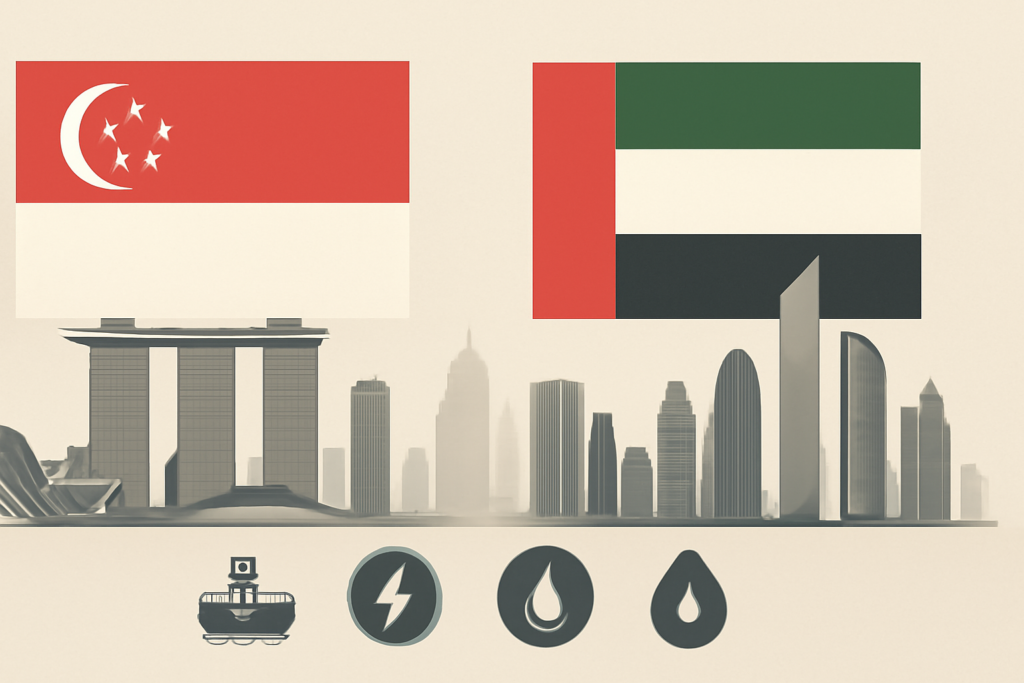
Singapore and the United Arab Emirates have agreed to launch formal negotiations on a Comprehensive Economic Partnership Agreement (CEPA), Prime Minister Lawrence Wong and UAE President Sheikh Mohamed bin Zayed Al Nahyan announced during Mr Wong’s official visit to Abu Dhabi on 21 October 2026.
The move, confirmed in a joint statement and Singapore’s Ministry of Foreign Affairs briefing, aims to deepen economic integration, facilitate trade and investment flows, and “create opportunities for businesses in both countries,” according to the MFA. The announcement came as the two leaders witnessed the exchange of three memorandums of understanding covering energy cooperation, water cooperation and disease vector control, and welcomed the establishment of a joint energy taskforce.
What was agreed in Abu Dhabi
The signed and witnessed agreements include:
- An MOU between Singapore’s Ministry of Energy, Trade and Industry and the Abu Dhabi National Oil Company (ADNOC) to establish a Joint Energy Taskforce.
- An MOU between Singapore’s Public Utilities Board (PUB) and the Abu Dhabi Department of Energy on water cooperation.
- An MOU between the National Environment Agency (NEA) of Singapore and the Abu Dhabi Public Health Centre on vector control cooperation.
The Joint Energy Taskforce is intended to identify opportunities across the energy value chain — from trading to infrastructure and downstream activities. The leaders also noted ongoing cooperation in nuclear energy involving the Emirates Nuclear Energy Company (ENEC). The joint statement further records progress on the UAE’s accession to the Digital Economy Partnership Agreement (DEPA), with Singapore chairing the UAE’s Accession Working Group.
Context and commercial significance
The UAE is Singapore’s largest trading partner in the Middle East and North Africa region. Non-oil bilateral trade was approximately US$6.5 billion in 2025, a 25% increase from 2024, the joint statement notes. The two countries mark close relations: their Comprehensive Partnership was established in 2019 and last year they commemorated 40 years of diplomatic ties.
For Singapore businesses and investors, a CEPA with the UAE could deliver a number of practical benefits if negotiations succeed: improved market access to the Gulf as a trading and re-export hub; deeper cooperation in energy trading and infrastructure projects; stronger channels for water and desalination technology exports and collaboration; and expanded commercial links in areas highlighted by both governments — AI, digitalisation, advanced technologies, defence and space.
The establishment of a formal energy taskforce and the continuing engagement on nuclear energy point to potential project-level collaboration in energy transition and security.
The announcement also coincides with Temasek’s plan to expand in the region: the Singapore state investor has said it will open offices in Riyadh and Abu Dhabi in the first half of 2027, subject to approvals. A larger Singapore investor presence in the Gulf may help accelerate deal flow, partnerships and joint ventures for local firms seeking to scale in the Middle East. Companies expanding into the region should also consider staffing and compliance needs, including work passes and accounting services for local operations, such as those related to employment passes and accounting services.
What businesses should watch
- Negotiation scope and timeline: The launch of CEPA negotiations is a political commitment to begin talks. Details — tariff offers, services commitments, investment protections, digital trade rules, mutual recognition arrangements and regulatory cooperation mechanisms — will be worked out during negotiations and can take many months or longer to conclude. Companies should monitor negotiation rounds for sector-specific outcomes.
- Energy projects and contracting: The Joint Energy Taskforce and ADNOC link make the UAE a more defined partner for Singapore firms in energy trading, downstream petrochemicals and energy transition projects such as blue/green hydrogen, carbon management and renewables-related infrastructure.
- Water and environmental technologies: The PUB–Abu Dhabi MOU potentially opens avenues for Singapore’s water-tech providers and research institutions to participate in desalination, water reuse and wastewater projects — priority areas for the UAE as it scales climate-resilient infrastructure.
- Regulatory and digital frameworks: Progress on DEPA accession and collaboration on digital economics suggests future trade facilitation and data-driven services measures may form part of broader economic ties; firms in fintech, cloud services and digital trade should track developments.
Strategic backdrop
Beyond bilateral economics, both leaders discussed regional security and multilateral cooperation. Singapore will chair ASEAN in 2027, and both sides signalled intent to advance ASEAN–GCC cooperation and to pursue negotiations toward an ASEAN–GCC Free Trade Agreement. The joint statement also emphasised joint priorities such as energy security, water resilience, and upholding a rules-based international order.
The launch of CEPA negotiations formalises an ambition to deepen a fast-growing commercial relationship between Singapore and the UAE. For Singapore companies and investors, the near-term opportunities will likely be clearest in energy, water and digital services, though the benefit of any agreement will depend on the eventual negotiation outcomes and the speed with which sectoral deals and projects move from declarations to contracts. Observers should expect incremental rather than immediate changes as working groups and negotiation rounds translate political momentum into legal and commercial commitments.